

Dubrovnik: Stradun - Heart of the City
Let's go.Map with locations



Information
Welcome to Dubrovnik: The Athens of the Adriatic
Dubrovnik, located at the southernmost tip of Croatia, is not only one of the most famous Mediterranean cities but also a symbol of freedom, diplomacy, and exceptional cultural heritage. Its imposing walls and rich history make it an essential destination for every traveler.
Founding and Historical Overview
The founding of Dubrovnik (Latin: Ragusa) dates back to the 7th century. According to legend, it was established by refugees from nearby Epidaurus (today’s Cavtat) after the Avar and Slavic invasions. However, the golden age of the city began in the 13th century, when it developed into an independent maritime power known as the Republic of Dubrovnik.
The Republic of Dubrovnik (1358–1808) was one of the most successful and long-lasting republics in the world. Renowned for its neutrality, clever diplomacy (“Not all the freedom in the world is for sale for gold”), and advanced trading skills, it managed to preserve its independence despite powerful neighbors such as the Ottoman Empire and Venice by paying tribute. The Republic had a well-developed legal system, progressive laws (including the early abolition of slavery in 1416), and a high level of literacy. Its independence came to an end in 1808 when it was abolished by Napoleon.
Geographical Location and Climate
Dubrovnik is situated at the foot of rugged limestone mountains in southern Dalmatia. The city is characterized by a Mediterranean climate (Csa), marked by warm and dry summers and mild winters.
Summer temperature: Average air temperatures in July and August range from 25°C to 28°C, but due to the southern location and humidity, the heat can feel intense.
Winter temperature: Winters are very mild, with average January temperatures between 9°C and 11°C. Temperatures below zero and snow are extremely rare.
Sea temperature: During summer, the temperature of the Adriatic Sea is pleasantly warm, reaching 24°C to 27°C.
The bura, a cold and dry northeasterly wind, sometimes blows in winter and brings exceptionally clear weather, while in summer the maestral often blows—a pleasant and refreshing breeze.
Dubrovnik – A City of Water Sports
Although perhaps not as famous for sporting “factories” as Split, Dubrovnik has a strong and trophy-rich sports tradition, particularly in water sports.
Water polo: VK Jug is by far the most famous and most successful sports club in Dubrovnik. It is one of the most decorated clubs in the world, a multiple European champion, and a holder of numerous domestic and international titles. Water polo is to Dubrovnik what basketball is to Split or football to Rijeka.
Swimming and Sailing: Surrounded by the sea, the city naturally supports the development of swimming and sailing clubs that have produced many Croatian national team athletes.
Football: Although football is popular, local clubs have not achieved the fame of giants like Hajduk or Dinamo, as the traditional focus has always been on water sports.
Dubrovnik is the birthplace of numerous Olympians and world champions, especially those connected to the sea.
Where to eat and drink?
Top Visit recommends
#1
#2
#3
#4
Events
Public transport & parking
Around Town by Bus
All parts of the city of Dubrovnik are well connected by frequent, regular bus lines
Tourist Information Offices of the Dubrovnik Tourist Board, Libertas kiosks, hotel receptions, etc.
Bus tickets can be purchased from newspaper vendors or on the bus. It is recommended to have exact change when buying a ticket from the bus driver. For more information, visit www.libertasdubrovnik.hr.
Local bus lines are the following numbers: 1A, 1B, 2, 2A, 3, 4, 5, 6, 7, 8, 9, and 17.
Boat Routes
Dubrovnik is connected to nearby islands by regular boat routes.
Boat to Lokrum Island
The boat to the island of Lokrum (special forest reserve in the vicinity of Dubrovnik) departs every half hour during the tourist season from the Old City Harbour (in the historic town centre) and docks at the island of Lokrum in Portoč Cove. The ride takes about ten minutes. Tickets can be purchased at the sales point of the Lokrum Reserve in Luža, at the entrance from the port. The boat does not operate in case of bad weather or during the winter. (www.lokrum.hr)
Boat to Elaphite Islands
The boat to the Elaphite Islands (Koločep, Lopud, and Šipan) departs from Gruž Port. The timetable can be found in the Jadrolinija office that is located immediately near the departure pier in Gruž or in the information offices of the Dubrovnik Tourist Board. Tickets can also be purchased at Jadrolinija offices. (www.jadrolinija.hr)
Boat to Mljet Island
During the tourist season, one can reach the island of Mljet by taking the Nona Ana hydrofoil that sails to Sobra and Polače Port, which is near Mljet National Park. For more information please contact the agency G & V Line. (www.gv-line.hr)
The Jadrolinija agency maintains a ferry route from the port of Prapratno located on the Pelješac Peninsula that operates year round. (www.jadrolinija.hr)
Boat to Mljet, Korčula, Hvar, Brač and Split
Fast catamarans, the Krilo Star and Krilo Eclipse, run from Gruž three or four times a week from May to October – and daily in high season. Tickets can be purchased online (www.krilo.hr) or from agents in town. Jadrolinija also has a catamaran from Dubrovnik to Korčula, Hvar, Brač and Split that runs every day from mid June to end of September.
Boat transfer on the route Gruž – Lapad – Gruž
If you walked to Gruž or you have just arrived in Dubrovnik by boat and you want to go to Lapad but you are tired, you missed the bus, there is no taxi … and for no particular reason at all, we suggest that you choose traditional local transport by boat. The Barka only operates in the summer, in the mornings (07:30 to 12:30), from Gruž – Lapad – Gruž, and at very reasonable prices. As soon as a small group of passengers is aboard, the ˝Barkarijol˝ (operator of the traditional boat Barka) switches on the motor and drives to the opposite side of the bay, without a set schedule, and approximately every ten minutes. In Gruž the boat docks directly in front of the open market, and on the Lapad side, it docks in front of Hotel Lapad. The boats features a sign that reads ˝Taxi˝, Gruž – Lapad – Gruž and the price.
Boat to Mljet/Lastovo
Changes to time-table are possible ! Please, check before travel !
Ship is not ferry, but a fast passenger ship, and as such cannot board vehicles of any kind!
TP Line’s ferry service connects Dubrovnik with Korčula and Lastovo throughout the year. Krilo’s catamaran line connects Dubrovnik with Mljet, Korčula, Hvar, and Split during the season.
Around Town by Car
Several petrol stations are located on roads to and in Dubrovnik. Some are open 24 hours.
If you decide to go to the Old City with your car, we recommend that you park at the public car park located at Ilijina Glavica, only five minutes’ walk from the Old City.
Street parking is marked with signs that display payment instructions and parking cost per hour. You can pay at parking meters or by using a mobile phone.www.sanitat.hr
There is a parking lot at Gruž Port that will be particularly useful if you decide to take a day trip to one of the islands in the Dubrovnik area because it is located in the immediate vicinity of the pier where the boats that connect Dubrovnik with the local islands dock.
More information: http://www.sanitat.hr/
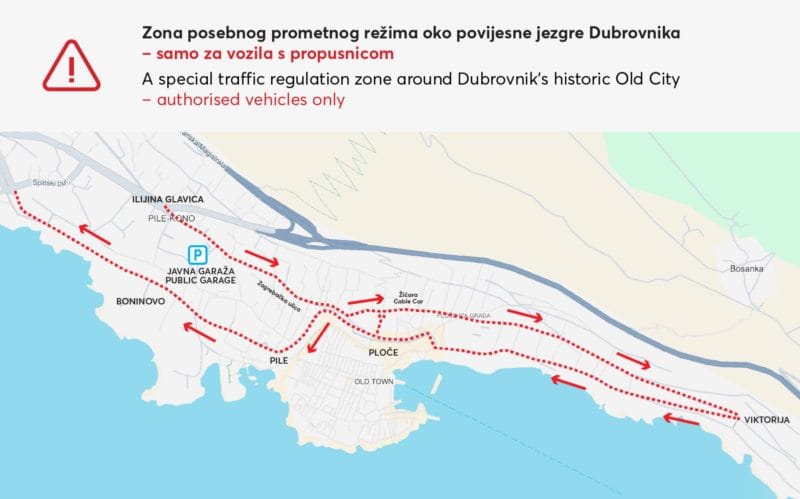
Dear Visitors,
The City of Dubrovnik has implemented a special Traffic Management System within the historic core and its buffer zone (hereinafter referred to as “the Zone”), with the aim of preserving cultural heritage and ensuring sustainable urban mobility.
Access by vehicle to the Zone is therefore restricted and permitted only under specific conditions from March 1 to November 30, as well as during special events or periods of increased traffic.
The Zone includes the entire area surrounding the Old City, stretching from the area of Ilijina glavica, along Zagrebačka Street to Viktorija, and across the areas of Pile to Boninovo. Only those with special approval will be allowed to enter the Zone.
The Zone begins at the traffic lights at the city entrance, near the public garage (see photo above).
From that point on, further vehicle access is limited and clearly regulated, so please take note of where vehicle access restrictions apply.
Visitors may enter the Zone only if they have arranged access in advance through one of the following:
- The Bus Web Shop – for vehicles with 7+1, 8+1, or 9–30 seats or more, with stopping permitted at the Pile and Ploče drop-off zones
- Pre-booked parking via the official app at parking lots located below the Dubrovnik Cable Car and at Pile
- If staying in private accommodation that includes garage parking, and the host has submitted the vehicle’s license plate in advance
- If staying in a hotel located within the Zone.
If you are arriving in Dubrovnik with a confirmed booking at a hotel or private property that includes a parking space, your accommodation provider should secure and confirm a parking place for you in advance, registering your vehicle registration plate number prior to your arrival or within 3 days upon your arrival.
If you are arriving without a prior accommodation reservation and enter the Zone by vehicle in search of a place to stay, please be aware that while entry is permitted for that purpose, your stay must still be properly registered in the official system. If you do not find accommodation, you will not be able to register your stay, as official registration requires confirmation from an authorised accommodation provider and you are not entitled to remain with your vehicle within the Zone.
In cases where you do find accommodation after entering the Zone, your hotel or private accommodation provider is required to register your stay within three days, in line with legal obligations.
If, however, you do not secure accommodation, to avoid a possible fine, you must leave the Zone and send an explanation within three days of entering the Zone to the following email address: zona@dubrovnik.hr. Your message should include your vehicle registration plate number, the date and time of your entry, and a short explanation of the circumstances. The City Administration will then assess your case and act accordingly.
We strongly advise all visitors to book accommodation in advance and to confirm with their host whether access to the Zone and parking arrangements can be secured prior to arrival.
Dubrovnik Launches Prepaid Parking Reservation System at Pile and Cable Car
A prepaid system for reserving parking spaces at Pile and the Cable Car lower platform has been launched—another smart city solution within Dubrovnik’s special traffic regime zone. This new service allows all users who book their spot in advance to enter the zone without interruption or risk of fines.
By purchasing a parking ticket online for a specific time slot, the system helps reduce congestion and promotes sustainable traffic management. It also significantly simplifies the process for users, who receive real-time information on available parking spaces and are automatically recognized by the system as vehicles with regulated access.
You can access the parking reservation system via the City of Dubrovnik’s official website, through the link HERE.
Let’s make Dubrovnik a more sustainable and pleasant city for both its residents and its visitors.
Street parking lots
Street parking lots are marked with special boards…
If you wish to visit the Old City with your own car, we recommend the multi-story car park at Ilijina Glavica (Zagrebačka ulica bb). It is open 24 hours and has 711 parking spaces. From there, a walk through The Bogišić Park or along Pero Budmani Street will take you down to the Old City in just 5 minutes. Street parking spaces are marked by signs that include payment instructions and hourly parking rates. Parking can be paid by parking coupons obtained at kiosks and at parking metres. Parking coupons must be fi lled in correctly and displayed under the front windscreen of your car. Please prepare the exact amount for the required number of parking hours, because the coin-operated parking machine cannot give you change. Apart from using an hourly parking ticket with its time limit, the user of the parking space should display a valid parking ticket on his car windscreen. The public car park at Gruž Harbour (Obala pape Ivana Pavla II 1) is also open 24 hours. For more information about parking visit
LOCATION
ON THE MAP
GO
NOW
Read more details
Church of St. Blaise and Its Origin
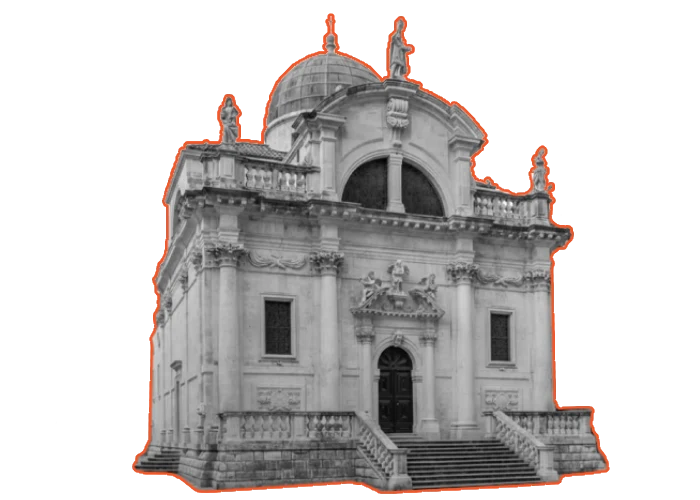
Here we stand before the Church of St. Blaise, one of Dubrovnik’s most beautiful sacred buildings. The church we see today dates from 1715 and captivates with its ornate Venetian Baroque style. It was built by the Venetian architect Marino Gropelli from 1706, following the request of the Dubrovnik Senate, which wanted a new church on the site of the old Romanesque one from the 14th century.
The Fire and the Miraculously Saved Statue
Its first damage occurred during an earthquake, and in 1706 it completely perished in a devastating fire. Everything was lost in the flames except, miraculously, the silver statue of St. Blaise. After spending its “exile” years in the small Church of St. Nicholas, where it was kept for safekeeping, the statue returned to its old place in 1715 — to the new church dedicated to the saint.
At that time, the people of Dubrovnik added a written note declaring that “all other statues made of gold, silver, and bronze had melted in the fire, while the saint’s statue, protected by a miracle, was taken out unscathed.” The statue is one of Dubrovnik’s most significant sculptures, and the model of the city held in the saint’s hand reveals the former architecture of Dubrovnik.
The Beginning of St. Blaise’s Veneration
To understand the greatness of St. Blaise and his importance to the people of Dubrovnik, we must look at the origins of his veneration. The first patron saints of Dubrovnik were St. Sergius and Bacchus. Dubrovnik chroniclers testify that in the second half of the 10th century, St. Blaise was chosen as the city’s protector.
The Legend of Stojko and the Defense of Dubrovnik
During the rule of Doge Pietro Candiano III, Venice sought a way to avoid paying tribute to the Croats and to protect itself from attacks by the Neretvan pirates. After setting out with around one hundred ships toward Greece, the Venetians asked the people of Dubrovnik for permission to enter the city to take on water and food. The citizens welcomed them and provided what they needed.
According to legend, around midnight, Stojko, the priest of the Church of St. Stephen, was praying inside when he noticed several armed young men and an elderly man among them. The old man revealed himself as the martyr Blaise and said that the soldiers were sent from heaven. He warned Stojko that the Venetians planned to seize the city and instructed him to alert the city council to prepare for defense. The Venetians attacked, but the people of Dubrovnik successfully repelled them. Because of this, in 972, St. Blaise was chosen as the protector of Dubrovnik — a legend recorded in the city’s oldest chronicles.
St. Blaise in the Symbols of Dubrovnik
After St. Blaise was chosen as the city’s patron in 972, the Great Council decreed that his image should be placed on the city coat of arms, the state banner, public buildings and walls, seals, coins, and official documents. Dubrovnik’s coins typically bore the image of St. Blaise on the front and Jesus on the back, accompanied by an inscription invoking the saint’s protection.
Celebration of the Feast of St. Blaise
The veneration of St. Blaise is best seen during the celebration of his feast day on 3 February, one of Dubrovnik’s most festive occasions even today. The tradition began when he was named the city’s protector. Initially modest, the celebration grew as Dubrovnik became a powerful city and the Republic expanded its territory.
The Freedom of St. Blaise
To allow everyone to take part, the “Freedom of St. Blaise” was introduced — a period during which any offender, convict, or exile could come into the city freely two days before and two days after the feast, without fear of punishment. This period was later extended to seven days before and seven days after the celebration.
On this feast day, the entire Republic came to the city — those who could not travel celebrated at home — carrying church banners and wearing traditional folk costumes, to bow before their saint, express gratitude for past protection, and entrust themselves and their loved ones for the future. The custom lives on today, with people preparing long and thoroughly for this solemn occasion.
The Inscription at Ploče Gate
At the eastern entrance to the city from the Ploče side — where our sightseeing route began — an inscription in Latin reads: “Away with you, savages! This fortress fears no one, for it is warmed by the breath of the holy elder!”
A Call to Visit the Church and Take a Break
Before continuing the tour, be sure to step inside the Church of St. Blaise and discover the miracle of the statue that survived the fire. If you wish, you can also rest on the square in front of the church — the many cafés offer the perfect place to relax with a view of one of Dubrovnik’s most beautiful Baroque façades.
Final Note
We will meet again in front of the nearby Rector’s Palace!
The voice guiding your journey
Take the quiz and test your knowledge
LOCATION
ON THE MAP
GO
NOW
Read more details
Position and Significance of the Rector’s Palace
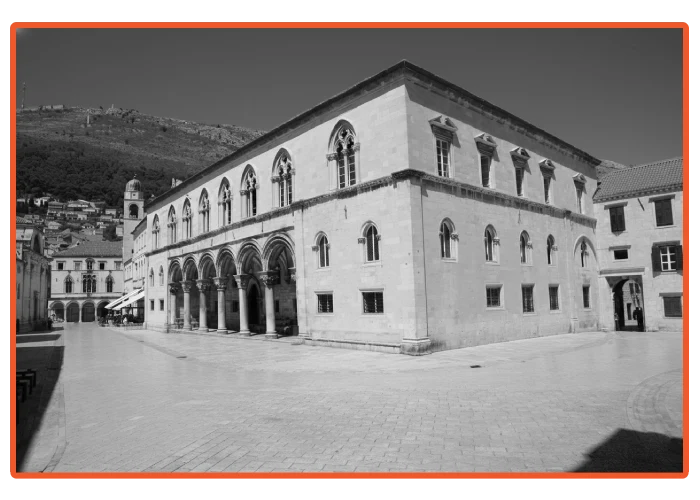
You are standing before the Rector’s Palace — perhaps the most renowned building in Dubrovnik, and certainly one that, if it could speak, would fill entire libraries with stories of its trials and triumphs. Throughout the centuries, it has endured more earthquakes, fires, and explosions than some cities have in their entirety.
The Palace was first mentioned in 1272 as a fortified castle and the administrative centre of Dubrovnik. It served as the residence of the rector and the seat of the Republic’s most important councils — a place where the city’s fate was shaped.
Residents and Rooms of the Rector’s Palace
Besides the rector and his family, the Palace housed the key-keeper and his household, guards, and prisoners. The rector’s chambers were located on the southern side of the first floor, while his family lived in smaller rooms overlooking the city port.
The most representative rooms were on the western part of the first floor, adorned with paintings and statues — most often of St. Blaise.
The furniture was made of walnut wood, gilded or painted, and some halls even had fireplaces with heating bricks.
The key-keeper’s quarters were on the mezzanine. He acted as caretaker, responsible for the prisoners, lighting, and maintenance of the rooms and halls. Ordinary soldiers slept on beds on the ground floor, sometimes even in the dungeons.
Prisons and the Notary Office
The prisons were located on the ground floor of the southern wing, close to the Criminal Court hall, and bore various names: “the dragon,” “the large one,” “the small one,” “the women’s prison,” and others.
The notary office was situated in the northern wing of the ground floor to allow easier communication with the public.
A History Marked by Disasters
This world was constantly shaken by misfortune — quite literally. The 1520 earthquake caused significant damage, and the catastrophic quake of 1667 nearly levelled the Palace entirely. Entire wings, halls, and even the rector’s chambers collapsed. On top of that, several fires struck over the years, and two major gunpowder explosions in the 15th century forced the rector to relocate multiple times.
It could be said that he was the most frequently displaced resident in Dubrovnik’s history — whenever the Palace burned, collapsed, or blew up, the rector had to pack his belongings and temporarily move into one of the municipal houses.
Imagine the scene — the most powerful man in the Republic, yet unsure whether he would wake up the next morning in his palace or in a “backup flat” a few streets away! Today, he might have appreciated a rental app, given how sudden and frequent those relocations were.
Reconstruction and a Symbol of Resilience
Despite all the destruction, the people of Dubrovnik always brought the Palace back to life. Each time, they restored it with great care, ensuring it preserved its Gothic-Renaissance appearance.
Thus, the Palace became a symbol of resilience and pride — proof that Dubrovnik never gives up, not even after earthquakes, fires, or explosions.
Entrance Decorations and Social Importance
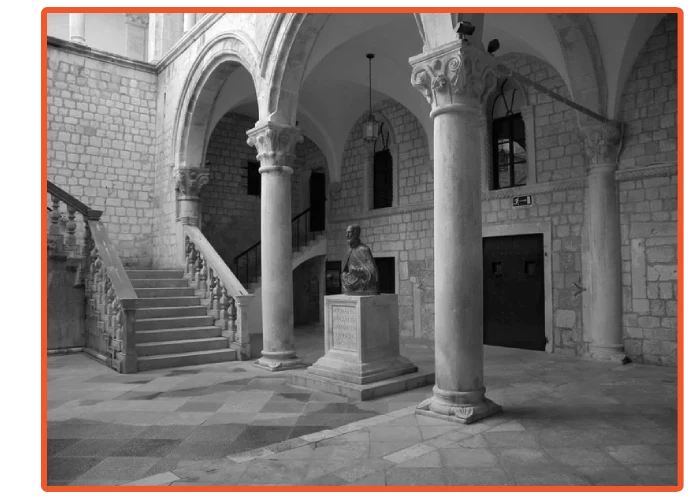
The two bronze mascarons and the door knocker on the main entrance were crafted by master Ubaldini. To the left of the entrance, a row of stone seats is carved, and to the right, two rows. These seats were reserved during festivals, processions, and public events for the rector, the bishop, and the nobility.
The Rector’s Palace and Marin Držić
The life of Marin Držić is closely interwoven with the Rector’s Palace. Although the exact location of his family home is unknown, records confirm it was situated near the Palace; Držić’s father, Marin, sold the house to pay his debts to creditors.
On 8 August 1463, Držić’s paternal grandfather, Nikola, was killed beneath the ruins of the Palace after a gunpowder explosion from the storage beneath the building.
Držić frequently visited the Palace when giving statements at the Chancellery, which had been housed in its premises since the 15th century.
The Statue of Miho Pracat and the Council’s Message
In the 17th century, the statue of benefactor Miho Pracat was placed in the atrium — the only monument ever erected by the Republic of Dubrovnik in honour of one of its citizens.
Above the entrance to the former council hall, an inscription delivered a clear message: “Forget the private, care for the public.”
Later Period and the Royal Palace
After the First World War, the Palace was renamed the Royal Palace and became the summer residence of the Karađorđević royal family. The residence occupied rooms on the first floor of the eastern and southern wings, as well as the upper part of the former Bell Tower, where the kitchen was located.
The Rector’s Palace Today
Today, thankfully, the Rector’s Palace no longer threatens to collapse nor faces explosions. Instead, it is a peaceful sanctuary of history — a museum where you can walk through the rooms where the city’s destiny was decided for centuries. Visitors can explore paintings, sculptures, furniture, and historical documents.
Instead of rectors and guards, you’ll meet tourists and curators, and the former prisons have become museum halls.
Before you stands an ancient palace, a silent witness to the struggles, earthquakes, and fires that shaped Dubrovnik — and a reminder that this city always finds a way to rise again.
The voice guiding your journey
Take the quiz and test your knowledge
LOCATION
ON THE MAP
GO
NOW
Read more details
In Front of the Dubrovnik Cathedral
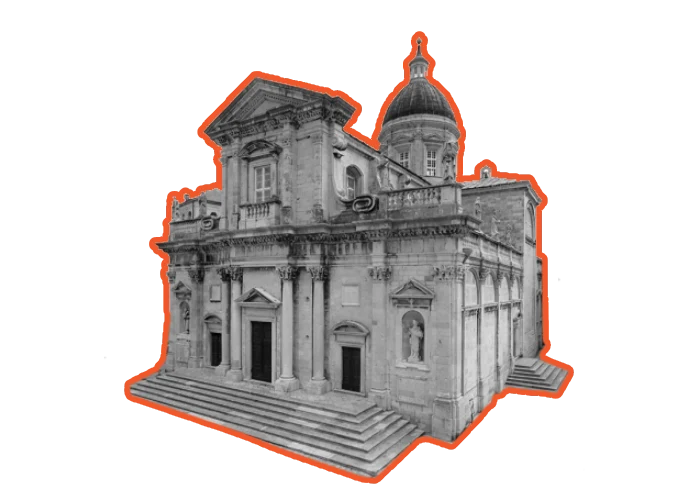
Here we are standing before the Dubrovnik Cathedral of the Assumption of Mary, known as Velika Gospa or simply “the Cathedral,” as the people of Dubrovnik call it.
The Legend of Richard the Lionheart
Two stories immediately come to mind for those familiar with local lore.
The first is the legend of the vow made by the English king Richard the Lionheart, who, according to tradition, was returning from the Third Crusade when he was caught in a storm and saved on the island of Lokrum. In gratitude, he donated a certain sum for the completion of the Cathedral of Mary.
Even today, upon special request, it is possible to visit the crypt located beneath the Baroque cathedral.
The Cathedral Treasury
The second story is tied to the extraordinary wealth of its treasury, which testifies to the impeccable reputation of Dubrovnik’s goldsmiths from the 11th to the 18th century and the artistic heritage of the Republic.
Inside the cathedral stands a reliquary containing 132 relics of saints dating from the 11th to the 19th century. Of priceless value are the relics of the head, arm, and leg of St. Blaise, crafted by Dubrovnik goldsmiths and dating between the 11th and 12th centuries.
The Security System of the People of Dubrovnik
Fully aware of its wealth — and traditionally wise, cautious, and suspicious — the people of Dubrovnik secured the treasure stored in the Cathedral with three keys.
One key was kept by the Rector, another by the Bishop, and the third by the Secretary of the Republic. Only when all three keys were turned simultaneously would the treasury door open before visitors.
Destruction in the Earthquake of 1667
The first cathedral, associated with Richard the Lionheart and known as a splendid Romanesque basilica with a dome, was completely destroyed in the great earthquake — along with most of the city’s landmarks — in the tragic year of 1667.
The New Baroque Cathedral
The old Romanesque cathedral, built between the 12th and 14th centuries, stood on the same site as the one standing today, which was erected anew after the disaster.
Stjepan Gradić and the Beginning of Reconstruction
In those tragic times for Dubrovnik, fate placed Stjepan Gradić in the Vatican — first as a curator and later as the rector of the Vatican Library.
A distinguished historian, philosopher, poet, and diplomat, he used his influence to gather aid for his devastated hometown.
Architects of the Reconstruction
Gradić succeeded in bringing some of the most renowned Italian architects to Dubrovnik, and his wish to have the new cathedral built in the contemporary Baroque style of church architecture was fulfilled by the architect Andrea Buffalini.
According to his plans, Paolo Andreotti began construction in 1672. The building process was long and included the efforts of many craftsmen.
The cathedral was finally completed in 1713 by the local master Ilija Katičić.
Artistic Value of the Interior
Inside this three-nave church with a dome, visitors will find a series of valuable altars with elements of the Late Baroque.
Particularly impressive are the works of the great Titian and his workshop above the main altar, as well as Raphael’s Madonna della Seggiola, Savoldo’s Flight into Egypt, and other notable pieces.
Archaeological Discoveries
The Dubrovnik Cathedral is not only a magnificent symbol of the city’s history and art but also an intriguing archaeological site that raises numerous questions about Dubrovnik’s first millennium.
While repairing the damage caused by the 1979 earthquake, archaeologists discovered the remains of yet another cathedral, older than the Romanesque one. Its dating to the 7th century suggests that Dubrovnik was already an established urban settlement at that time, shifting the timeline of the city’s origins.
Marin Držić and the Cathedral
To conclude the story of the Cathedral, here is a historical detail about Marin Držić — the renowned Croatian Renaissance playwright, poet, Catholic cleric, church musician, and theatre actor from Dubrovnik, known as the “father of Croatian drama.”
Držić as the Cathedral Organist
On the last day of February 1538, with no votes against, Marin Držić was elected as the cathedral organist with an annual salary of one hundred perpers.
His salary was paid from several sources: seventy perpers were provided by the cathedral administrators, twenty by the treasurers, and ten by the administrators of the Church of St. Blaise.
Držić also mentions the Cathedral in the ninth scene of the first act of his comedy Dundo Maroje.
Dživo suggests to Pera, Maro’s fiancée, that they visit the Roman Church of St. Peter, to which she asks:
“Is it as big as Our Lady?”
He is surprised that she knows the size of the Dubrovnik Cathedral, and she explains:
“Poor Dživo, how would I not know? Every Christmas I went to Our Lady with my aunt to attend Mass!”
Through this dialogue, the author clearly highlights the position of women in his time — their limited freedom of movement in public spaces, especially if they were of noble birth, and the fact that young women could not go out unaccompanied.
Return to the Present
And that is the story of times long past. Now we return to the present — see you soon at Gundulić Square!
The voice guiding your journey
Take the quiz and test your knowledge
Only part of the route is shown.
The rest of the content is available in the full, unlocked version of the guide.
